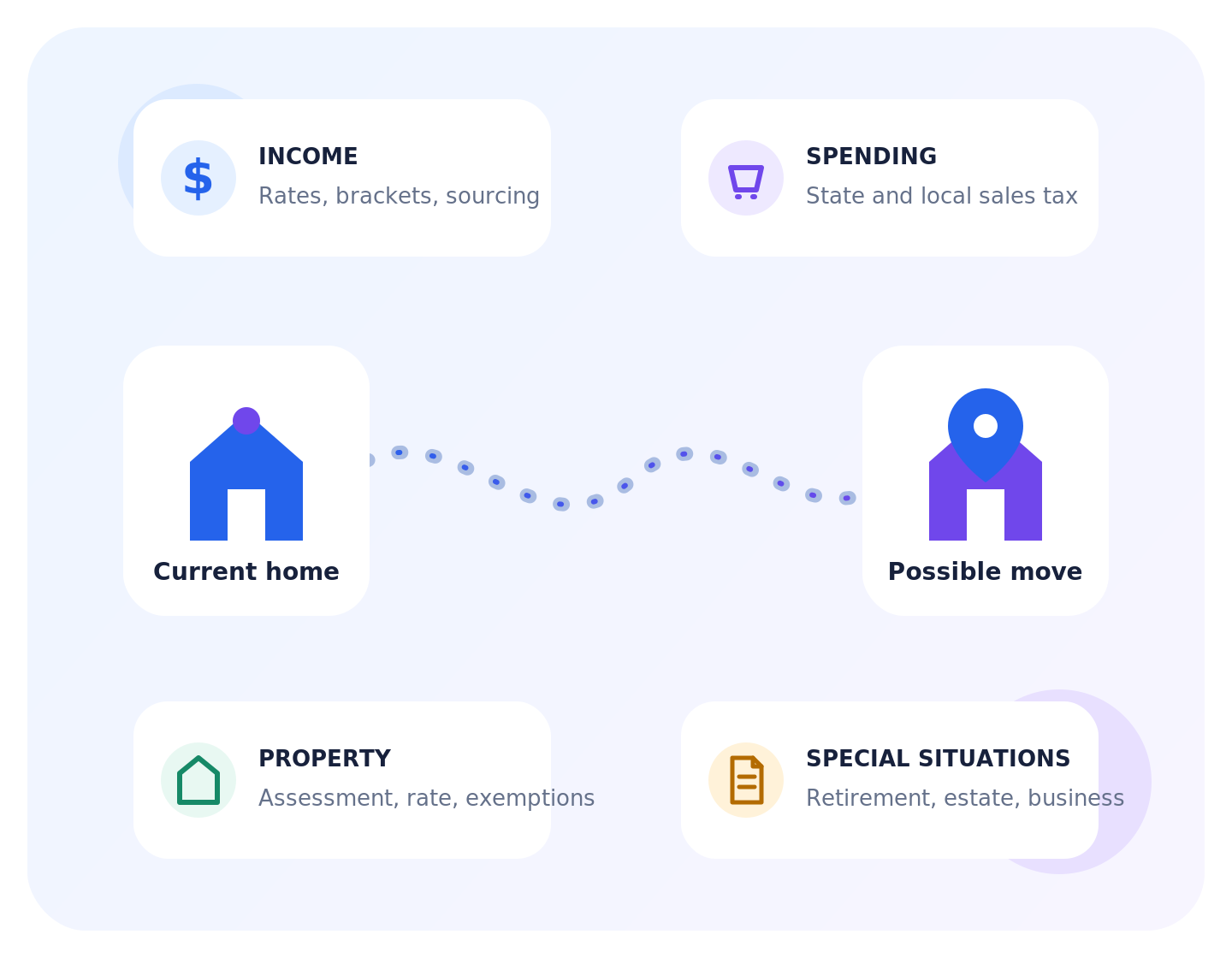
The planning framework
Start with your household, then compare jurisdictions.
State averages are useful for screening, but a defensible relocation comparison needs the actual places and facts involved. USAGov notes that state and local obligations can include taxes on income, real estate, personal property, and purchases—and directs taxpayers to state and local agencies for exact amounts and rules.
Define the move
Use exact candidate locations when possible. City, county, and special-district boundaries can matter.
Model your household
Start with realistic income and exact locations. Record the other household facts you will need to investigate beyond the homepage estimate.
Separate the tax layers
Review income, sales, and property estimates first; then investigate retirement, estate, business, and transaction-specific rules.
Verify before acting
Confirm material findings with the relevant tax agency, assessor, and a qualified adviser familiar with both locations.
The tax layers
What to investigate before a move
The IRS groups state and local income or general sales taxes, real property taxes, and personal property taxes as distinct categories for federal itemized-deduction purposes. That same separation is useful for relocation planning—even though deductibility and the underlying state tax bill are different questions.
Earnings and distributions
State and local income tax
Compare more than the headline rate. Brackets, deductions, credits, residency, and where income is earned can all change the result.
Questions worth answering
- Does the state use a flat rate, progressive brackets, or no broad individual income tax?
- Does the destination impose a county or city income tax?
- How are wages, business income, capital gains, pensions, and retirement-account distributions treated?
- Will a part-year or nonresident return be required during the move year?
Everyday spending
Sales and use tax
A statewide rate is only the starting point. Local additions and product-specific exemptions determine what a household actually pays.
Questions worth answering
- What combined state-and-local rate applies at the destination address?
- Are groceries, prescription drugs, services, or major purchases treated differently?
- Does the state impose use tax on taxable purchases made elsewhere?
- How closely does a generic spending assumption match your household?
Housing and ownership
Real and personal property tax
The bill depends on the local jurisdiction and assessment system—not just the state or the home’s purchase price.
Questions worth answering
- What assessed value, assessment ratio, and local rate will apply?
- Are homestead, senior, veteran, disability, or income-based programs available?
- How often are properties reassessed, and can ownership changes reset the value?
- Are vehicles or other personal property taxed locally?
Situations that need separate review
Retirement, estate, inheritance, and business taxes
These rules can be decisive, but they are too household-specific to infer safely from a simple statewide rate comparison.
Questions worth answering
- How does the state treat Social Security, pension income, and retirement-account withdrawals?
- Could estate or inheritance tax apply to the household or its beneficiaries?
- Will a company owe franchise, gross-receipts, payroll, or entity-level taxes?
- Do domicile and business-presence rules create obligations in more than one state?
Transparent by design
What TryClarityTax estimates today
The headline comparison estimates three recurring categories: state and available local income tax, estimated sales tax, and estimated property tax. The homepage accepts two locations and optional annual income; it does not currently expose controls for the other assumptions.
Homepage defaults: $100,000 annual income when omitted, $500,000 home value, single filing status, no over-65 adjustment, and taxable spending equal to 35% of annual income.
Included in the headline estimate
- • State and available local income tax
- • Estimated sales tax
- • Estimated property tax
Requires separate investigation
- • Retirement-income treatment
- • Estate and inheritance tax
- • Business, franchise, and other taxes
- • Every deduction, credit, exemption, and local levy
Check the primary source
Official references
Tax rules change. Use these references to verify the rules that materially affect your decision, then confirm address-specific property information with the relevant local assessor or finance office.
Common questions
Avoid the most common comparison mistakes
Is a state with no individual income tax always less expensive?
No. A household can face different sales, property, insurance, housing, and other costs. Compare the categories that apply to your circumstances rather than ranking states by one rate.
Can I estimate property tax from a home’s market value alone?
Not reliably. The taxable assessment, assessment ratio, local levies, exemptions, credits, and reassessment rules can all affect the bill. The local assessor or finance office is the best source for an address-specific estimate.
Does TryClarityTax provide tax or legal advice?
No. TryClarityTax provides educational estimates for early planning. It does not prepare a return, determine domicile, or replace advice from a qualified professional.
Turn the framework into a first comparison.
Use two real candidate locations and your household income. The result is a planning screen—not a filing determination.
Compare my locations